
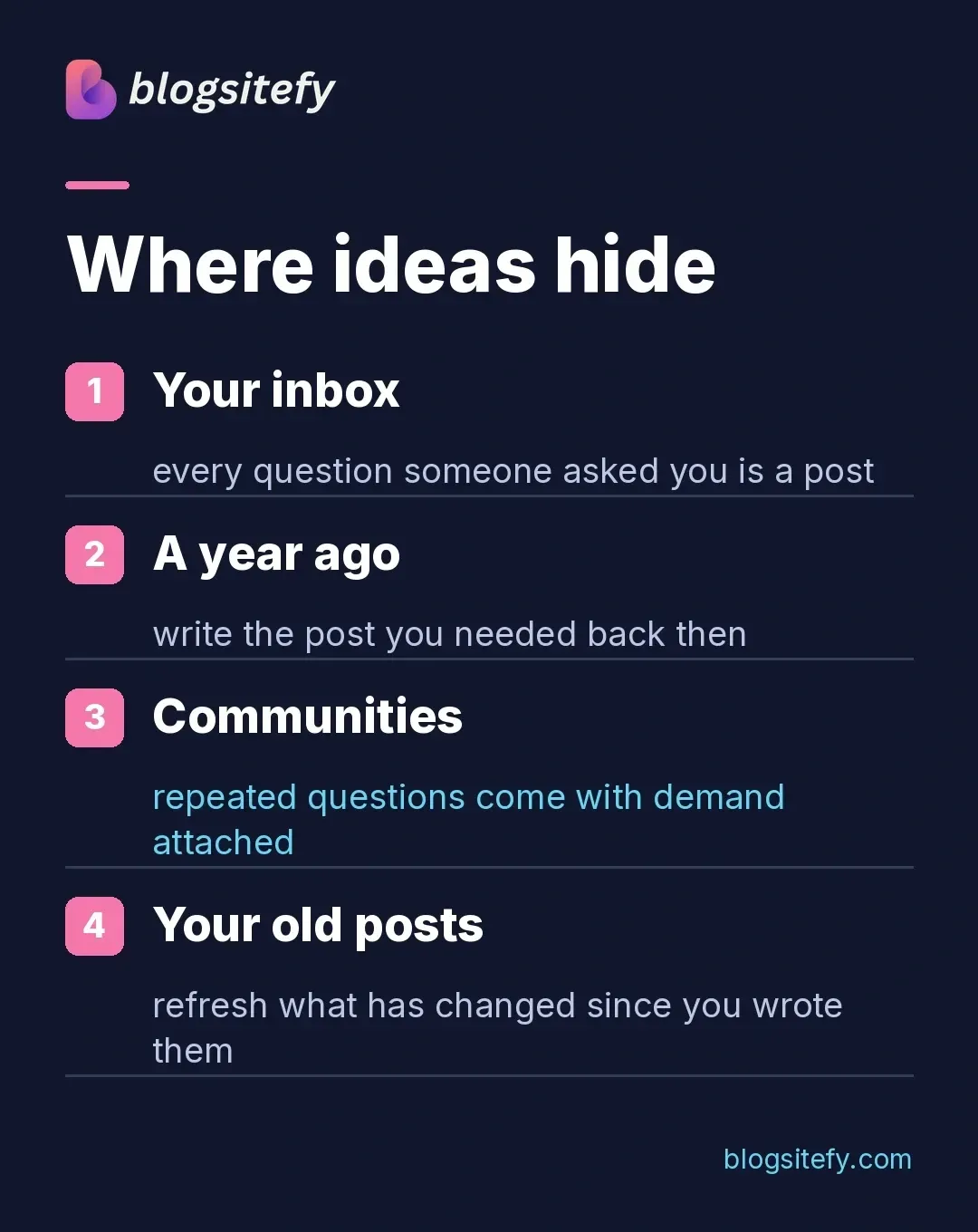
The short answer: your next posts are hiding in four places: the questions people already ask you, the problems you solved a year ago, the questions that keep coming up in your communities, and your own oldest posts. Mine one of them today and the blank page is gone.
Every blogger hits the blank page. The ideas are not gone. They are hiding in places you stopped looking. Here is where to find them.
Start here: where ideas hide
Where to look | What to mine | Try this |
Your sent folder | Questions you already answered | Search for "how do I" |
Your own past | Problems you solved a year ago | Write to the beginner version of you |
Communities | Questions that keep coming up | Search your niche on Reddit or forums |
Your old posts | Topics that changed since you wrote them | Refresh one with what you know now |
Answer the questions people already ask you
Emails, comments, messages. A question someone asked you can be a useful post idea. It shows one real reader needed an answer, not how many people search for it. A quick way to mine them:
Open your sent folder.
Search for "how do I".
Every hit is a question a real person trusted you to answer.
Say your blog is trailbites.com. A friend asks which snacks survive three days in a backpack without a fridge. That is a post: a real list, storage notes, and what to skip.
Write the post you needed a year ago
You solved real problems to get where you are. The beginner version of you is still searching for those answers. Write to them. Google's own guidance for creators asks whether content shows first-hand expertise and a depth of knowledge, and this is the easiest place to show it.
Look at what people ask in communities
Forums, Reddit, Facebook groups in your niche. Search your topic and read the questions. A question that keeps coming up is a lead worth investigating, not proof of search demand. Use Google Trends to compare relative search interest for your topic, location and time range. Its scores are not search-volume totals, and a low-volume term can show zero. Treat a trend as one signal alongside what your readers need.
Go narrower, not broader
"Marketing tips" is empty. "How a home baker gets her first ten catering orders" is a post. A small question gives you a clear scope to answer well. It does not guarantee an easier ranking.
Update something old
Reread your oldest posts. What has changed since you wrote them? Refreshing an old post with what you know now is new value without a blank page. Before you rework older posts, make sure you can always get your content out; here is a simple backup checklist.
Keep the list somewhere simple
A note on your phone is enough. One line per idea, captured the moment it shows up. If you already draft in Google Docs, that works too; you can write there and publish on your own domain. The blank page is only scary when the list is empty.
Where this advice comes from
Key sources used in this post:
Google's guidance for creators: first-hand expertise and depth of knowledge, in Google's own words.
Google Trends: check how demand for a topic is moving.
Frequently Asked Questions
Try keeping ten ideas as a starting buffer, then adjust it to your publishing schedule. An idea still needs a useful angle before it becomes a post.
Yes. Answer from your experience, for your reader. Specific and honest beats big and generic.
Try one more specific question, or ask a reader where they get stuck. If the topic no longer has useful questions for your audience, revisit its scope.
No. Some questions deserve two paragraphs. Publish those too. Short and useful beats long and padded. Google's own guidance for creators confirms it has no preferred word count.
Share this post